Condenser was solid with dust from a remodel. He cleaned it, rechecked the current the fan was drawing, and was honest that with the cabinet boxed in this tightly it will need doing again before long.
Vance P.2026-02-01
Independent Sub-Zero specialists · Fleming Island, Clay County
Monday – Friday 8:00am – 6:00pm Call (904) 201-3304
A Sub-Zero built-in has two sealed systems, and they fail in different ways. How to read a warm refrigerator with a freezer that is still holding temperature.
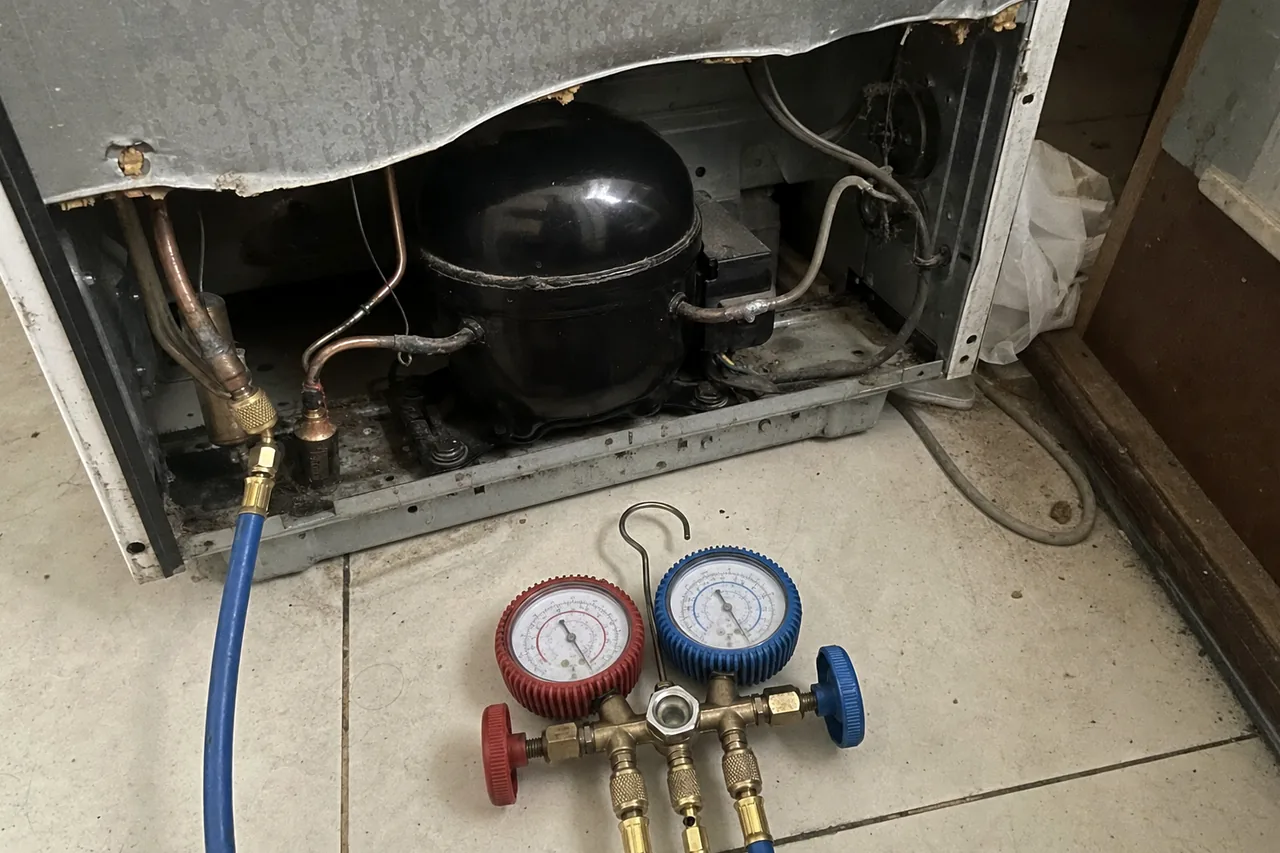
The call comes in the same way most weeks. The refrigerator side has been getting warmer for a few days, milk is going off early, and the freezer below it is still hard-frozen. The owner has usually concluded the appliance is dying.
It is almost always the opposite of that.
A Sub-Zero built-in of the classic pattern does not cool one compartment and bleed air into the other. It runs two separate sealed systems, each with its own compressor, its own evaporator and its own charge of refrigerant. One serves the fresh food compartment, one serves the freezer.
That design exists for a reason unrelated to repair. Two systems mean the freezer can be kept dry and cold while the refrigerator is kept humid and cool, instead of forcing one evaporator to do both jobs and dehydrating everything in the process. The side effect is diagnostic. When one compartment fails and the other does not, the fault is inside the failing system and the rest of the appliance is fine.
In rough order of how often we find them.
The evaporator fan for that compartment has stopped or slowed. Cold is being produced and is not being moved. The tell is a refrigerator that is warm at the top and cool at the bottom, and often a quieter appliance than it used to be.
The air path is blocked. Something is pressed against the outlet, or a drawer has been packed to the back wall. Simple, common, and free to fix.
The defrost cycle on that evaporator has failed and it has iced over. Cold air cannot get through a block of frost. This one builds over a couple of weeks and sometimes recovers briefly after the door is left open, which confuses people into thinking the problem comes and goes.
A door that is no longer sealing. Warm humid air entering continuously will keep a compartment above its set point indefinitely, and in Clay County humidity that happens faster than owners expect.
The control, or a sensor telling the control a temperature that is not true.
The sealed system itself. It is on the list, but it is at the bottom of it, and a technician who starts here rather than ends here is guessing.
If the freezer and the refrigerator climb at the same time, the story changes completely. Two independent systems do not fail simultaneously by coincidence. Look instead at what they share: the condenser and its airflow, the electrical supply, the control board, and the ambient temperature of the room.
The most common finding is the least dramatic one. The condenser behind the upper grille is choked with dust — considerably more than dust in a house with dogs — and both systems are trying to reject heat into a coil that cannot take it. The appliance runs continuously, never catches up, and gets worse on hot afternoons. Cleaning the coil ends a real proportion of those calls.
Not from a symptom list, and not from a sound. It is diagnosed by measuring: what each compartment is genuinely holding against what it reports, how the suction line and the condenser feel and read at various points, whether the compressor is drawing what it should, and whether the system pressures make sense for the ambient conditions.
Opening a sealed system is a deliberate act with legal obligations. Refrigerant is recovered into approved equipment, not vented, and the work is done by technicians holding EPA Section 608 certification. If somebody proposes topping up a refrigerator with refrigerant as a routine measure, be careful — a sealed system does not consume refrigerant, so if it is low, it is leaking, and the leak is the repair.
If the finding is a leak in the evaporator inside the cabinet insulation, or a failed compressor on an older unit, that is a large job, and it should arrive as a written number set against the age and condition of the appliance. Sometimes the honest recommendation is not to proceed. That conversation belongs before the work, not after it.
What should not happen is a compressor being replaced because a fan motor and a dirty coil were never checked.
The bands below are the ones this note is about. They are completed repairs, parts and labour together, on top of a flat diagnostic visit that is credited toward the work.
| Work | Typical range |
|---|---|
| $80 diagnostic visit | $80 |
| Compressor or sealed-system repair | $870–$2,460 |
Ranges, not quotes: the firm figure is written down after the diagnosis and nothing is ordered or billed until you have approved it. On this page the work we describe runs from $80 for the visit to about $2,460 at the top of the band above. The whole book of bands is on the pricing page.
A flat $80 covers the visit and the diagnosis. It is credited toward the repair if you go ahead with the work.
4.3 out of 5 across 62 customer reviews. Read every one of them.
Condenser was solid with dust from a remodel. He cleaned it, rechecked the current the fan was drawing, and was honest that with the cabinet boxed in this tightly it will need doing again before long.
Vance P.2026-02-01
Meltwater kept appearing at the base of the unit. He traced it to a drain line blocked where it leaves the liner, flushed it and refitted the clip that keeps the heat loop against the tube.
Marguerite D.2026-03-14
Frost was creeping across the rear wall of the fresh food side and nothing else looked wrong. It was the defrost termination sensor reading high, which he showed me on the meter before replacing it.
Sabine K.2026-05-20